Academics at Terra Schola
What is Offered at Terra Schola
At Terra Schola, we strive to teach so students don’t just learn information, they learn how to use it.
Our approach combines strong academic instruction with real-world application, helping students understand not only what they are learning, but why it matters.
Our Curriculum Approach
At Terra Schola, we follow the British Columbia (BC) Curriculum, a well-respected framework known for focusing on true understanding—not just memorization.
Instead of rushing through large amounts of content, this approach helps students slow down, think deeply, and truly learn. It emphasizes building skills that students will use not only in school, but throughout their lives.
A Focus on Lasting Skills
The BC Curriculum is built around developing essential skills, including:
- Critical thinking
- Creativity
- Communication
- Personal responsibility
These skills help students become capable, confident learners who are prepared for future academic success and everyday life.
What This Means for Your Child
Your child won’t just be asked to remember information; they will learn how to use it.
Thinking Critically and Solving Problems
Students are encouraged to ask questions, explore ideas, and think through challenges. Rather than being given all the answers, they learn how to figure things out, make connections, and solve problems independently.
Applying Learning to Real Life
Lessons are designed to connect to the real world. Whether through projects, discussions, or examples, students see how their learning applies outside the classroom, making it more meaningful and easier to understand.
Communicating Clearly
Students practice sharing their ideas through speaking, writing, and discussion. They learn how to explain their thinking, listen to others, and express themselves with confidence and clarity.
Taking Responsibility for Their Learning
Students are guided to take ownership of their progress. They set goals, reflect on their work, and learn how to manage their time and responsibilities with increasing independence.
Project-Based Learning
Students learn through meaningful projects that connect their lessons to real life.
Instead of only completing worksheets, students might:
- Design a solution to a real-world problem
- Create presentations, models, or written work
- Apply what they’ve learned across multiple subjects
Projects are guided by teachers and aligned to learning standards, ensuring students build both knowledge and practical skills.
Core Courses
Math
Learning Through Real World Application
Math at Terra Schola focuses on understanding, not memorization.
Students learn math by applying skills to real-life situations, such as:
- Budgeting and planning
- Measuring and building
- Analyzing data and solving problems
- Exploring patterns and logical thinking
These projects help students see how math is used in everyday life, making learning more meaningful and easier to understand.
Science
Learning Through Exploration
Science is taught through curiosity, observation, and discovery.
Students:
- Ask questions about the world around them
- Explore natural systems and how they work
- Conduct simple investigations and experiments
- Learn how science connects to real-world challenges
Science learning encourages students to think critically and understand their role in the environment.
English Language Arts (ELA)
Learning Through Expression and Understanding
In English Language Arts, students build strong communication skills.
Students:
- Read a variety of texts to build understanding
- Write for different purposes (informational, narrative, persuasive)
- Practice clear and confident communication
- Reflect on ideas and connect learning to their own lives
ELA helps students become thoughtful readers, writers, and communicators.
Social Studies
Learning Through Connection
Social Studies helps students understand people, communities, and the world.
Students:
- Explore history and how it shapes the present
- Learn about cultures, communities, and systems
- Discuss real-world issues in age-appropriate ways
- Understand their role as members of a community
This builds awareness, empathy, and a sense of responsibility.
Scheduling
Our School Calendar
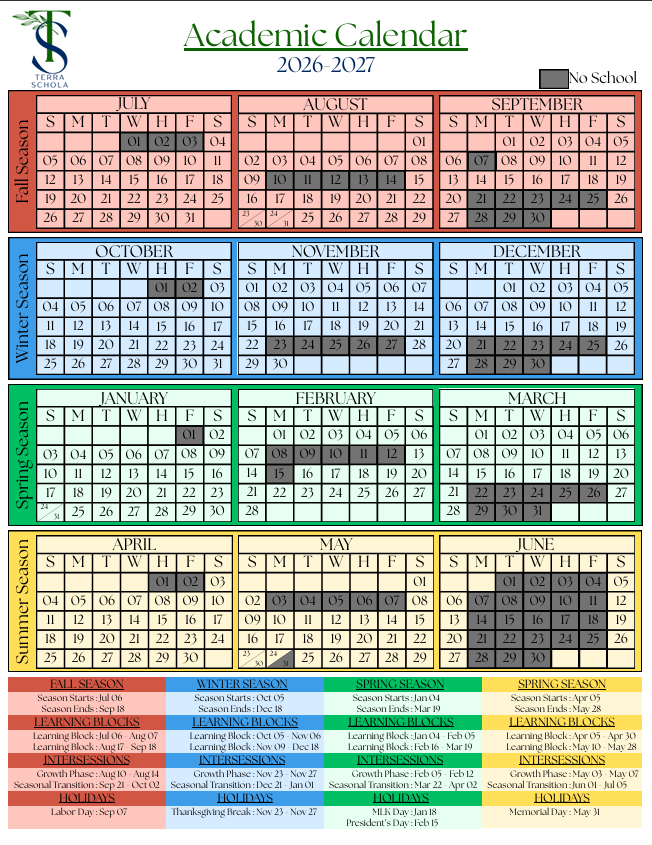
Terra Schola is a year-round school, designed to support consistent learning while also building in time for rest and reset.
Instead of one long school year with a long summer break, we follow a seasonal schedule that helps students stay engaged without feeling overwhelmed.
Why This Matters for Students
This structure helps students:
- Stay engaged without burnout
- Retain what they learn over time
- Have regular opportunities to rest and reset
- Return to learning feeling refreshed and ready
A Day at Terra Schola
Our schedule is designed to keep students focused, supported, and balanced.
Short breaks are built in throughout the day so students can move, reset, and stay focused.
Our Day starts at 9am Central Standard Time, and Ends at 4pm Central Standard Time
Morning
- Start the day with reflection and goal-setting
- Movement and yoga to help students feel calm and ready
- Teacher-led lessons and discussion
Midday
- Independent work to practice and apply learning
- Lunch and time to rest and recharge
Afternoon
- More teaching and collaborative learning
- Independent work or projects
- End the day with reflection
How We Teach
Tools We Use
We use simple, reliable tools to keep learning organized and connected. These tools help create a smooth and consistent learning experience.

Gibbon
Tracks attendance, schedules, and school information

Moodle
Where students access lessons, assignments, and materials

Microsoft 365 and Teams
Used for live classes, communication, and completing work
A Balanced Approach
Eco-Spirituality
(What This Means at Terra Schola)
Students experience a mix of:
- Direct instruction from teachers
- Guided practice
- Independent work
- Project-based learning
This balance helps students build strong academic skills while also developing confidence, independence, and critical thinking.
Eco-spirituality, in our context, simply means:
- Respect for nature and the environment
- Understanding that humans are part of a larger system
- Encouraging care, responsibility, and awareness of the natural world
This is taught through environmental learning, reflection, and real-world connections.